Hey, did you take in the previous Scene? Well, if you’re eagerly awaiting the next Scene,
The Reddening, rest assured that it won’t be much longer, but there are some other preliminary matters I need to address first.
I hope you’ll read this through and give me your feedback in the comments…
If you have begun to follow Stenn’s adventures (and, admittedly, they are only just beginning) then you’ve noticed that my write-up of Stenn’s Opening Scene really leaned into narrative, while the following Scene, Blood Dust & Sky Glyphs, was a mixture of narrative, dice rolls, and oracle queries and answers.
Now, I love the feel of rolling dice, the tactile experience. The next best thing for me personally is blogging die rolls, like I did in Scene Blood Dust. But … because Substack does not support user-created stylesheets, it is not convenient for me to picture actual dice rolls — not in the way that it is convenient for me to do on my HTMLy blog (where I can use custom HTML and CSS).
This isn’t a bad thing — it just is; part of the appeal of Substack is its accessibility, and by limiting formatting options it can ensure attractive posts that are readable on both desktop and mobile screens.
Therefore, I need a sort of Actual Play shorthand, something that is concise and easily interleaved with little chunks of narrative. And there will be narrative. But what I hope to do as this solo campaign gets warmed up — and moves toward hitting its stride — is to use little clusters of narrative (here, a paragraph; there, two of them) as the Substack equivalent of what cut scenes are in videogames.
<
p>So, let’s think about what we want out of our Actual Plays. We want to record what happens to our protagonist in an entertaining manner — hopefully entertaining enough that other people will want to read them. We want to do this in a way that doesn’t slow us down so much that it pulls us out of the solo-flow. Say what?
Solo-flow is the flow state in solo roleplaying that occurs when a player becomes fully immersed in the game, losing track of time and self-consciousness while engaging deeply with the narrative and mechanics. This experience is enhanced by having clear goals, balanced challenges, and immediate feedback, allowing for a rewarding and enjoyable gameplay experience.
I can’t stay in solo-flow if I can’t quickly record things like the following and interleave them seamlessly and nearly effortlessly with prose elements. I need to be able to record what is happening without notably slowing down play. I need to be able to record and track longitudinal changes of game state, such as NPCs, locations, threads (to borrow a Mythic GME construct).
And the shorthand for game state needs to be able to memorialize data; I need to be able to go back and find out what Roderick’s supply of healing potions was last session, how much progress Stenn has made made towards tracking down Navare, where my collapsing dice pool countdown toward the witch coven’s enchantment was the last time I checked on them…
Here’s my starting point for shorthand:
- for player actions
- ? for oracle questions
- d: for mechanics rolls
- -> for oracle results
- => for consequences
The above are the Five Essentials. Anything and everything else is optional — Scene headers, Campaign headers, tracking of complex plot points, tracking threads. The five symbols above (> ? d: -> => ) handle the Three Main Things: Actions, Resolutions, and Consequences.
If you’re familiar with Markdown, you’ll immediately see how the following example lends itself to that format; but this will work fine if you’re taking hand-written notes.
Example:
S1 Dark alley, midnight
> Sneak past the guard
d: Stealth 4 vs TN 5 => Fail
=> I kick a bottle. Guard turns!
? Does he see me clearly?
-> No, but... => He's suspicious, starts walking toward the noise
By putting the above in a code block, we set it off from any adjacent narrative chunk of text. Here’s how it looks on my HTMLy blog:
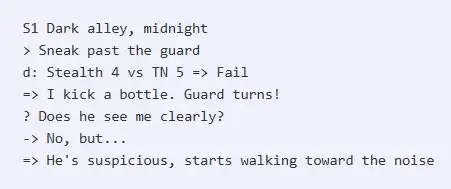
That’s fairly terse. It conveys quite a bit of information in a small space. The first line above sets the scene for us: it’s Scene #1, we’re in a dark alley and it’s about midnight; line two starts with the action symbol: ‘>’ So it’s understood that Sneak past the guard is an action our protagonist (usually a PC, i.e., Player Character) is taking. Line 3 starts with the letter ‘d:’, which signals us that dice have been rolled to resolve how un/successful we were at sneaking past the guard. In this example, we weren’t. Now look at line 4.
The ‘=>’ symbol says “And here’s what the dice result means… “I kick a bottle. Guard turns!” is our in-the-moment interpretation of the failed die roll. So the guard turns toward the noise, but has he spotted me? Time to ask the oracle. A line beginning with ‘?’ means “ask the oracle”. When we ask the oracle, we’re asking the game-world a question. We roll some dice and see what the oracle replies. The final line above begins with the Consequences symbol, ‘=>’ where we interpret the oracular response.
My decision on whether or not to use this shorthand notation has to additionally take into account that it might prove a deterrent to people reading/enjoying my Actual Plays.
I can see myself using condensed notation like this if I weren’t blogging Actual Plays but instead was only keeping AP records for my own personal use.
Well, perhaps that’s too technical for some people’s taste, but I need to decide whether to adopt some version of it, or instead write everything out long-form — which inevitably will yank me out of solo-flow. Let me know what you think in the comments!