
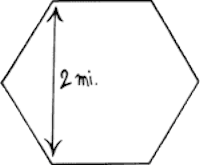
For the sake of simplicity, let's assume that unless otherwise stated, travel occurs during daylight conditions, and that a single 2-mile hex is traversed hourly. Let's further assume that a character can cover six of these hexes daily — and that this incorporates rest stops, brief hunting for game, time for meals, time for backtracking. That's 12 miles per day with no ticks against Body stress track, so long as weather conditions aren't extreme, there is adequate food and water, and that after such a day's travel you're getting 6+ hours of rest, if not sound sleep.
The above assumptions are for the usual travel circumstances, business as usual. This doesn't preclude the possibility of traveling under cover of complete darkness — although night-time travel in the Endless Rime campaign is usually avoided simply because of plummeting temperatures making it very uncomfortable and hazardous.
Given our "most of the time" travel assumptions outlined in the first paragraph, let's stipulate that daily travel (could be done nightly instead) — minus breaks, hunting, meals — amounts to six hours and covers 12 miles if the terrain isn't difficult. For the sake of game mechanics, we'll break a day's travel into three 2-hour phases: Morning, Midday, Afternoon legs of travel. Under optimal conditions, our PC will travel 4 miles in each of those phases.
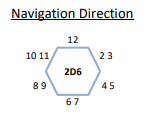
There will be some long-time hex crawlers who read this and will argue that a PC can cover 18-24 miles in a day. I will simply say that terrain in 35th millennium B.C. will be assumed to have been extremely rugged, and that this (as well as breaks, hunting, combat, backtrack/re-routing delays, etc.) account for the slower travel.
With regard to the Endless Rime campaign, set in the Upper Neolithic 35,000 years ago, all overland travel counts as hex-crawling, since there are no roads or large man-made landmarks by which to navigate. However, in a later post I will incorporate a mechanic to take into account whether or not a PC has traveled a given hex multiple times and may have developed some internal map of the area and thus have the benefit of familiarity.
Our loop for each of these phases of daily travel (Morning, Mid-Day, Afternoon):
The typical procedure for travel is as follows: 1. The GM declares the terrain type and current travel round. 2. Each player declares an activity. 3. The GM rolls for random encounters according to the danger level. 4. Each Activity and random encounter is resolved in a logical order determined by the GM. Typically, player character activities are resolved first. 5. Changes in location, terrain, time of day, character condition etc, are noted. 6. Back to 1
Check for Random Encounters twice in each of the three phases of daily travel.
Comments