HTMLy

The Annals of Glen Forkovian

Algorithm for Hex Crawling

- Posted in Solo-RP by - Comments

For the sake of simplicity, let's assume that unless otherwise stated, travel occurs during daylight conditions, and that a single 2-mile hex is traversed hourly. Let's further assume that a character can cover six of these hexes daily — and that this incorporates rest stops, brief hunting for game, time for meals, time for backtracking. That's 12 miles per day with no ticks against Body stress track, so long as weather conditions aren't extreme, there is adequate food and water, and that after such a day's travel you're getting 6+ hours of rest, if not sound sleep.

The above assumptions are for the usual travel circumstances, business as usual. This doesn't preclude the possibility of traveling under cover of complete darkness — although night-time travel in the Endless Rime campaign is usually avoided simply because of plummeting temperatures making it very uncomfortable and hazardous.

Given our "most of the time" travel assumptions outlined in the first paragraph, let's stipulate that daily travel (could be done nightly instead) — minus breaks, hunting, meals — amounts to six hours and covers 12 miles if the terrain isn't difficult. For the sake of game mechanics, we'll break a day's travel into three 2-hour phases: Morning, Midday, Afternoon legs of travel. Under optimal conditions, our PC will travel 4 miles in each of those phases.

There will be some long-time hex crawlers who read this and will argue that a PC can cover 18-24 miles in a day. I will simply say that terrain in 35th millennium B.C. will be assumed to have been extremely rugged, and that this (as well as breaks, hunting, combat, backtrack/re-routing delays, etc.) account for the slower travel.

With regard to the Endless Rime campaign, set in the Upper Neolithic 35,000 years ago, all overland travel counts as hex-crawling, since there are no roads or large man-made landmarks by which to navigate. However, in a later post I will incorporate a mechanic to take into account whether or not a PC has traveled a given hex multiple times and may have developed some internal map of the area and thus have the benefit of familiarity.


Alternatively, we could use the Kal-Arath Overland Travel algorithm:

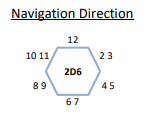
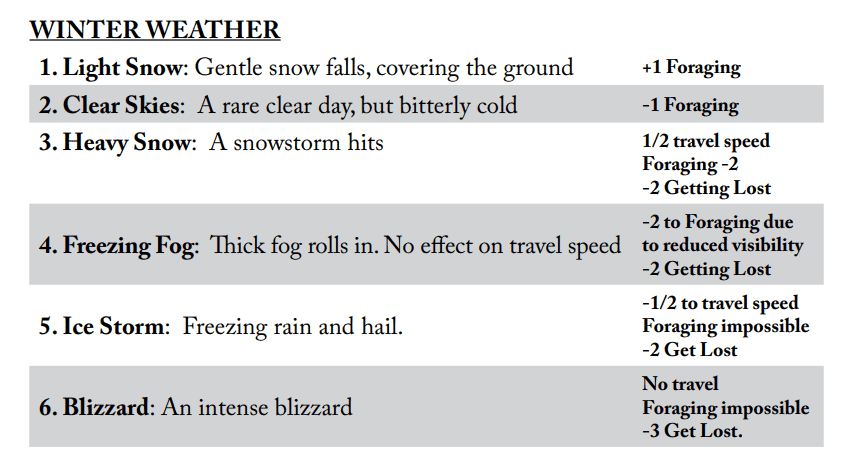
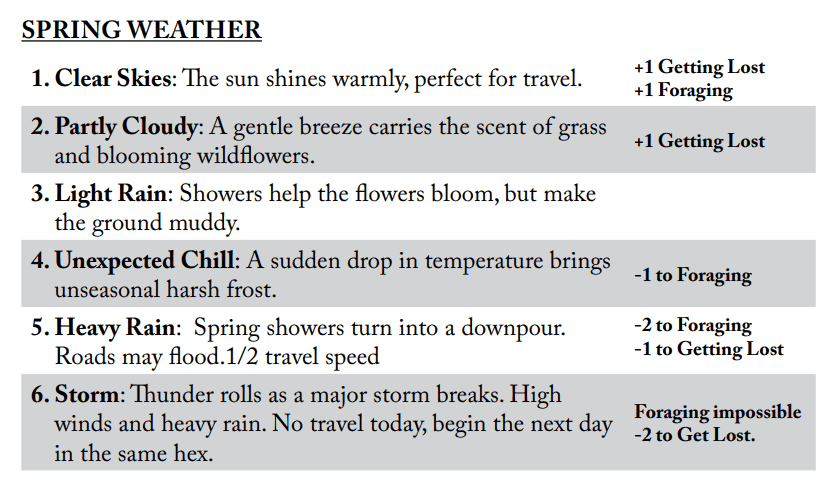
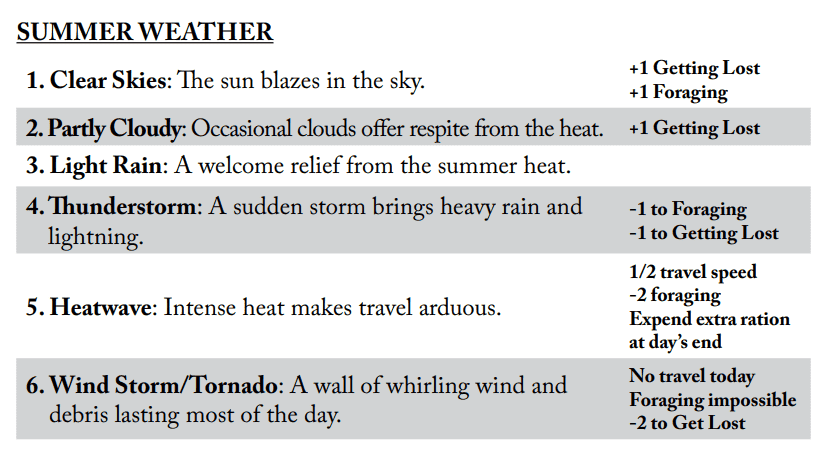
Step 1: Determine Weather

Step 2: Am I Lost?

A result of 1-2 on d6 means you are Lost. You don't leave the current hex today, and must spend tomorrow finding your way out of it. You can Forage while Lost, and Weather modifiers apply.

If you are following a river, roadway, or specific landmark, you don't get Lost.

Once Lost, rolls to Get Lost are made at a disadvantage unless a skill mitigates this, and results of 1–2 imply the character is still lost and makes no progress.

Lost characters or parties still roll for POI and Encounters.

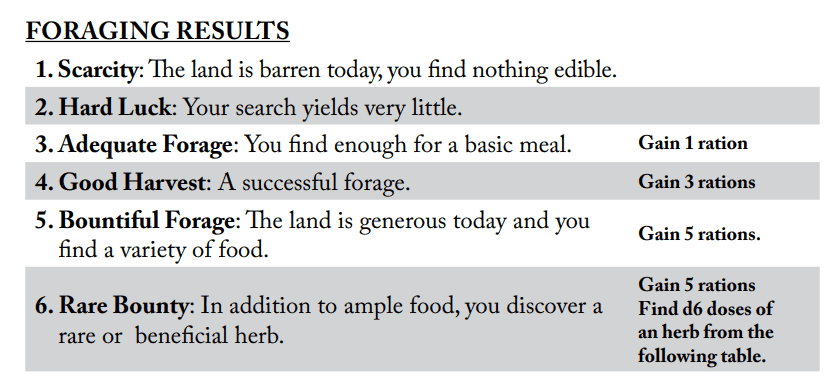
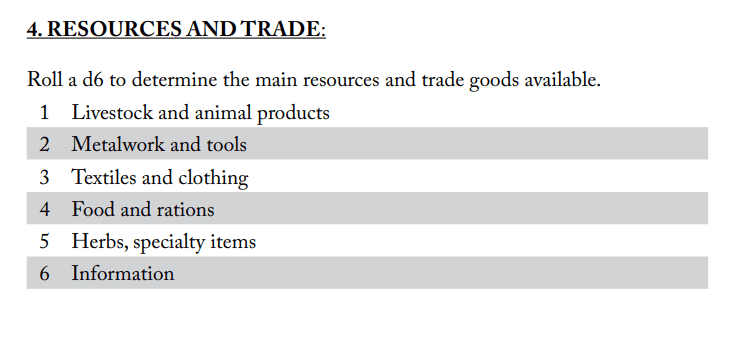
Step 3: Forage

If the party chooses or needs to forage for food and water, or other resources, make a roll to determine the success of their efforts.

Weather can affect this.

Foraging reduces the day’s movement to 50% of whatever it would be normally (after considering weather).

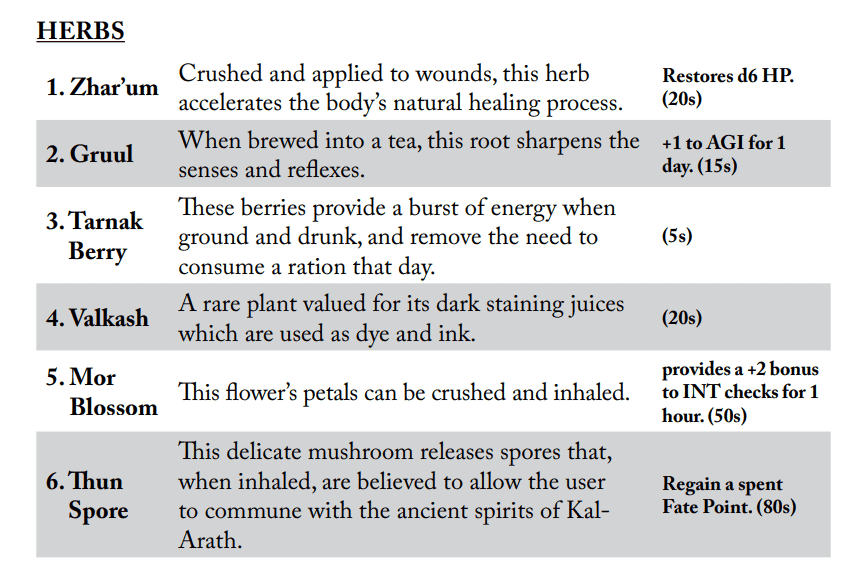
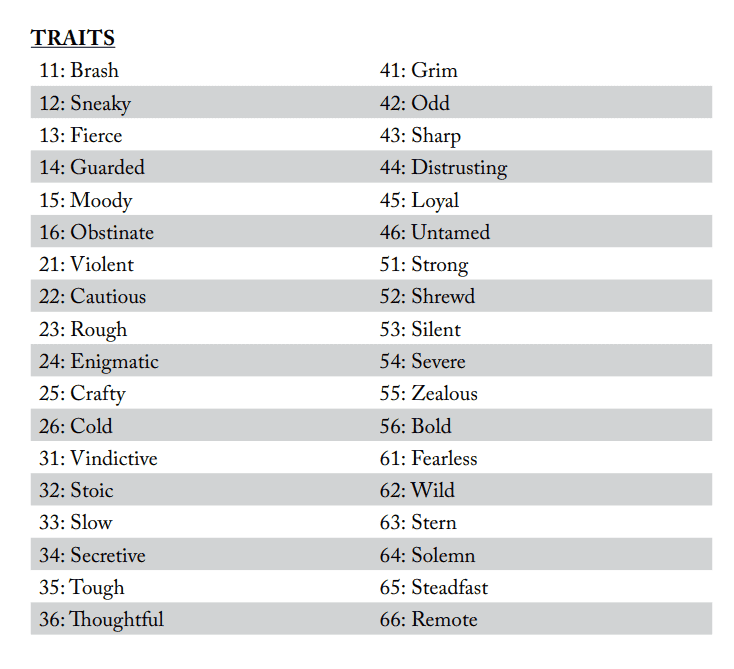
Herbs

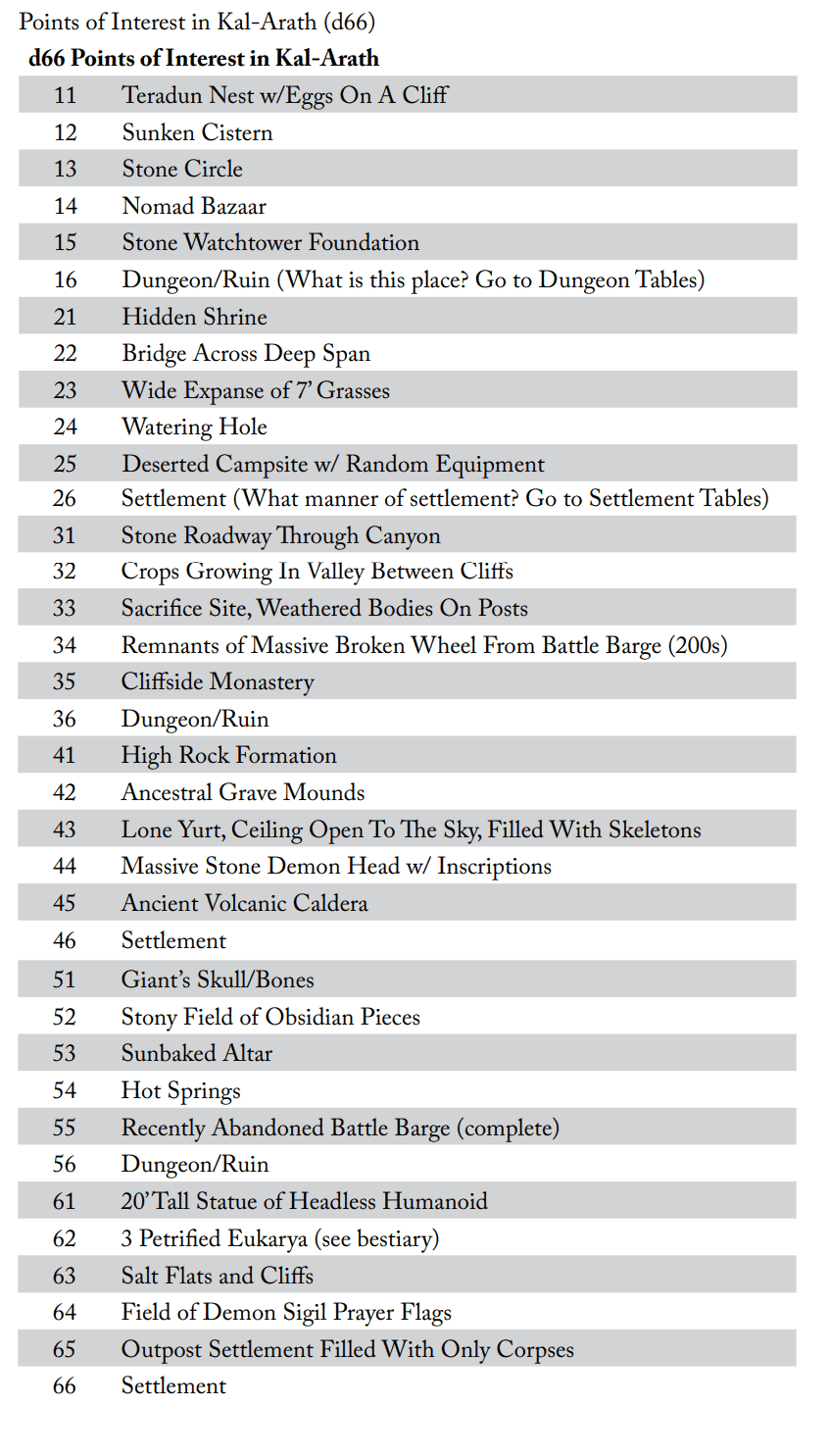
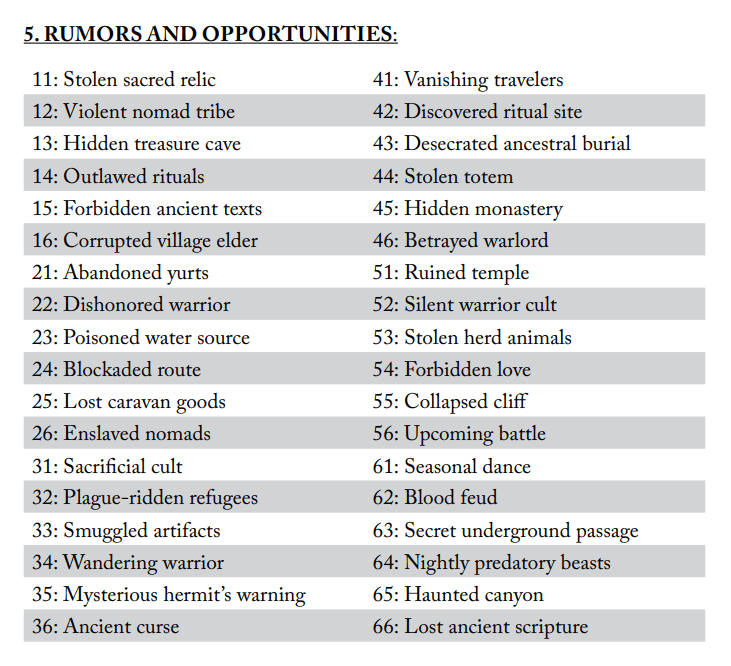
Step 4: Points of Interest

You find a POI on a 5-6 on d6:

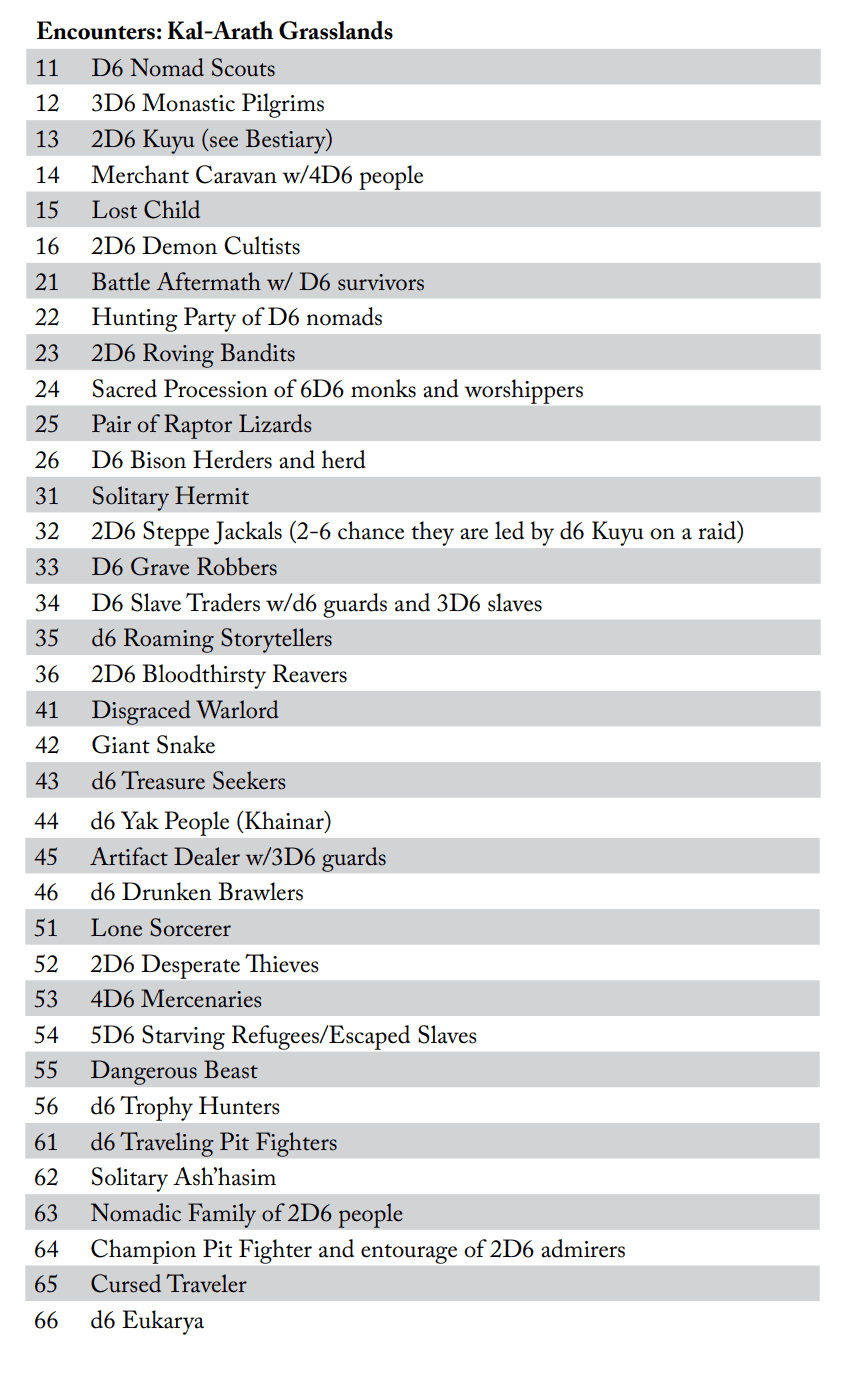
Step 5: Encounters

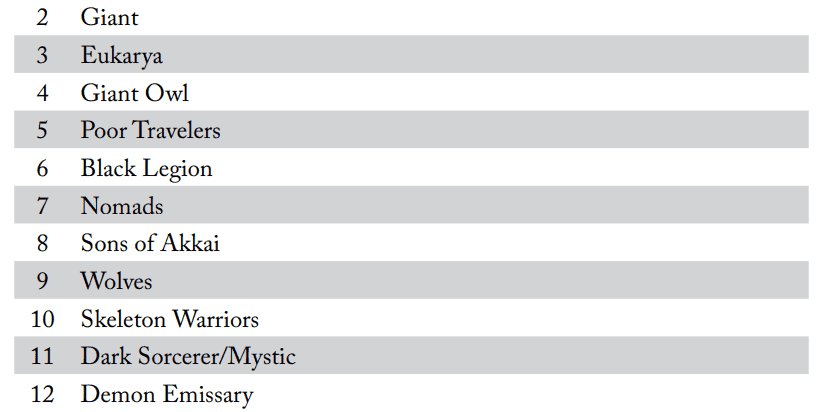
Determine if the party has an encounter during their travels. On a 5–6, use the encounter chart below. All Encounters then use a Reaction Check to determine disposition, although this can be done using advantage/disadvantage depending on circumstances or what type of creature is encountered:

When an Encounter doesn't immediately jump off into violence, consider using Kate Korsaro's Compass Points to Adventure table.

Step 6: Camp, Spend Resources, and Recover:

At the end of the day’s travel, the party makes camp. They will need to expend a ration and can attempt to heal any wounds or conditions. Check for night-time encounter (1–2 on d6):

Step 7: End of Day / End of Session?

Summarize the day’s events in your journal, update the party’s status, roll for any meaning or turning points if necessary, prepare for the next day of travel, or end your session.


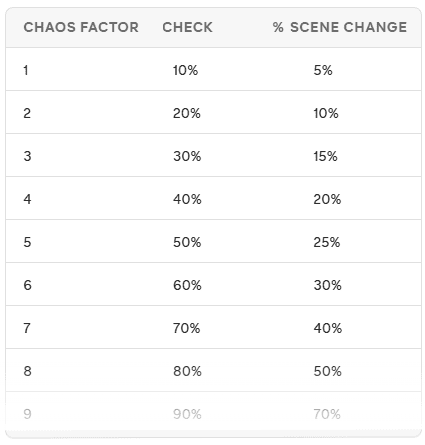
Check for Scene Change

- Posted in Solo-RP by - Comments

Algorithm For Hex Crawling

- Posted in Solo-RP by - Comments

For the sake of simplicity, let's assume that unless otherwise stated, travel occurs during daylight conditions, and that a single 2-mile hex is traversed hourly. Let's further assume that a character can cover six of these hexes daily — and that this incorporates rest stops, brief hunting for game, time for meals, time for backtracking. That's 12 miles per day with no ticks against Body stress track, so long as weather conditions aren't extreme, there is adequate food and water, and that after such a day's travel you're getting 6+ hours of rest, if not sound sleep.

The above assumptions are for the usual travel circumstances, business as usual. This doesn't preclude the possibility of traveling under cover of complete darkness — although night-time travel in the Endless Rime campaign is usually avoided simply because of plummeting temperatures making it very uncomfortable and hazardous.

Given our "most of the time" travel assumptions outlined in the first paragraph, let's stipulate that daily travel (could be done nightly instead) — minus breaks, hunting, meals — amounts to six hours and covers 12 miles if the terrain isn't difficult. For the sake of game mechanics, we'll break a day's travel into three 2-hour phases: Morning, Midday, Afternoon legs of travel. Under optimal conditions, our PC will travel 4 miles in each of those phases.

There will be some long-time hex crawlers who read this and will argue that a PC can cover 18-24 miles in a day. I will simply say that terrain in 35th millennium B.C. will be assumed to have been extremely rugged, and that this (as well as breaks, hunting, combat, backtrack/re-routing delays, etc.) account for the slower travel.

With regard to the Endless Rime campaign, set in the Upper Neolithic 35,000 years ago, all overland travel counts as hex-crawling, since there are no roads or large man-made landmarks by which to navigate. However, in a later post I will incorporate a mechanic to take into account whether or not a PC has traveled a given hex multiple times and may have developed some internal map of the area and thus have the benefit of familiarity.

Our loop for each of these phases of daily travel (Morning, Mid-Day, Afternoon):

The typical procedure for travel is as follows: 1. The GM declares the terrain type and current travel round. 2. Each player declares an activity. 3. The GM rolls for random encounters according to the danger level. 4. Each Activity and random encounter is resolved in a logical order determined by the GM. Typically, player character activities are resolved first. 5. Changes in location, terrain, time of day, character condition etc, are noted. 6. Back to 1

Check for Random Encounters twice in each of the three phases of daily travel.

Meta Data for Your Solo Campaign

- Posted in Solo-RP by - Comments

title: 
ruleset: 
genre: 
player: 
pcs: 
start_date: last_update: 
tools:
themes: 
tone: 
notes:

Solo Flow

- Posted in Solo-RP by - Comments

Hey, did you take in the previous Scene? Well, if you’re eagerly awaiting the next Scene, The Reddening, rest assured that it won’t be much longer, but there are some other preliminary matters I need to address first.

I hope you’ll read this through and give me your feedback in the comments…

If you have begun to follow Stenn’s adventures (and, admittedly, they are only just beginning) then you’ve noticed that my write-up of Stenn’s Opening Scene really leaned into narrative, while the following Scene, Blood Dust & Sky Glyphs, was a mixture of narrative, dice rolls, and oracle queries and answers.

Now, I love the feel of rolling dice, the tactile experience. The next best thing for me personally is blogging die rolls, like I did in Scene Blood Dust. But … because Substack does not support user-created stylesheets, it is not convenient for me to picture actual dice rolls — not in the way that it is convenient for me to do on my HTMLy blog (where I can use custom HTML and CSS).

This isn’t a bad thing — it just is; part of the appeal of Substack is its accessibility, and by limiting formatting options it can ensure attractive posts that are readable on both desktop and mobile screens.

Therefore, I need a sort of Actual Play shorthand, something that is concise and easily interleaved with little chunks of narrative. And there will be narrative. But what I hope to do as this solo campaign gets warmed up — and moves toward hitting its stride — is to use little clusters of narrative (here, a paragraph; there, two of them) as the Substack equivalent of what cut scenes are in videogames.

<

p>So, let’s think about what we want out of our Actual Plays. We want to record what happens to our protagonist in an entertaining manner — hopefully entertaining enough that other people will want to read them. We want to do this in a way that doesn’t slow us down so much that it pulls us out of the solo-flow. Say what?

Solo-flow is the flow state in solo roleplaying that occurs when a player becomes fully immersed in the game, losing track of time and self-consciousness while engaging deeply with the narrative and mechanics. This experience is enhanced by having clear goals, balanced challenges, and immediate feedback, allowing for a rewarding and enjoyable gameplay experience.

I can’t stay in solo-flow if I can’t quickly record things like the following and interleave them seamlessly and nearly effortlessly with prose elements. I need to be able to record what is happening without notably slowing down play. I need to be able to record and track longitudinal changes of game state, such as NPCs, locations, threads (to borrow a Mythic GME construct).

And the shorthand for game state needs to be able to memorialize data; I need to be able to go back and find out what Roderick’s supply of healing potions was last session, how much progress Stenn has made made towards tracking down Navare, where my collapsing dice pool countdown toward the witch coven’s enchantment was the last time I checked on them…

Here’s my starting point for shorthand:

  • for player actions
  • ? for oracle questions
  • d: for mechanics rolls
  • -> for oracle results
  • => for consequences

The above are the Five Essentials. Anything and everything else is optional — Scene headers, Campaign headers, tracking of complex plot points, tracking threads. The five symbols above (> ? d: -> => ) handle the Three Main Things: Actions, Resolutions, and Consequences.

If you’re familiar with Markdown, you’ll immediately see how the following example lends itself to that format; but this will work fine if you’re taking hand-written notes.

Example:

S1 Dark alley, midnight
> Sneak past the guard
d: Stealth 4 vs TN 5 => Fail
=> I kick a bottle. Guard turns! 
? Does he see me clearly? 
-> No, but... => He's suspicious, starts walking toward the noise

By putting the above in a code block, we set it off from any adjacent narrative chunk of text. Here’s how it looks on my HTMLy blog:
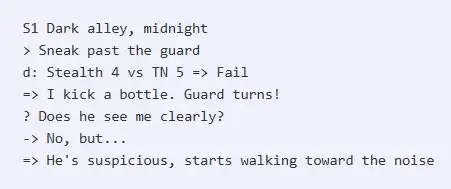
That’s fairly terse. It conveys quite a bit of information in a small space. The first line above sets the scene for us: it’s Scene #1, we’re in a dark alley and it’s about midnight; line two starts with the action symbol: ‘>’ So it’s understood that Sneak past the guard is an action our protagonist (usually a PC, i.e., Player Character) is taking. Line 3 starts with the letter ‘d:’, which signals us that dice have been rolled to resolve how un/successful we were at sneaking past the guard. In this example, we weren’t. Now look at line 4.

The ‘=>’ symbol says “And here’s what the dice result means… “I kick a bottle. Guard turns!” is our in-the-moment interpretation of the failed die roll. So the guard turns toward the noise, but has he spotted me? Time to ask the oracle. A line beginning with ‘?’ means “ask the oracle”. When we ask the oracle, we’re asking the game-world a question. We roll some dice and see what the oracle replies. The final line above begins with the Consequences symbol, ‘=>’ where we interpret the oracular response.

My decision on whether or not to use this shorthand notation has to additionally take into account that it might prove a deterrent to people reading/enjoying my Actual Plays.

I can see myself using condensed notation like this if I weren’t blogging Actual Plays but instead was only keeping AP records for my own personal use.

Well, perhaps that’s too technical for some people’s taste, but I need to decide whether to adopt some version of it, or instead write everything out long-form — which inevitably will yank me out of solo-flow. Let me know what you think in the comments!

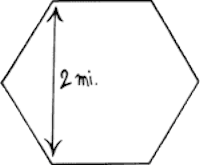
Calling all solo roleplayers, what’s on your play-list for 2026? Here’s what Santy Klaus done brung me: Across A Thousand Dead Worlds comes in as the heavyweight. Dolmenwood is on my Eventually list. Lichdom caught my eye, and it likely won’t be the last of these that I try out. I’ve heard some high praise for Morkin, and want to try it. The Sandbox Generator was just intriguing looking and very inexpensive, and I thought, “Why not?” Finally, I picked up a write-up of the West Marches style of campaign. You can read about it at various places on the internet, but why not support the creator, right? What’s on YOUR list?